
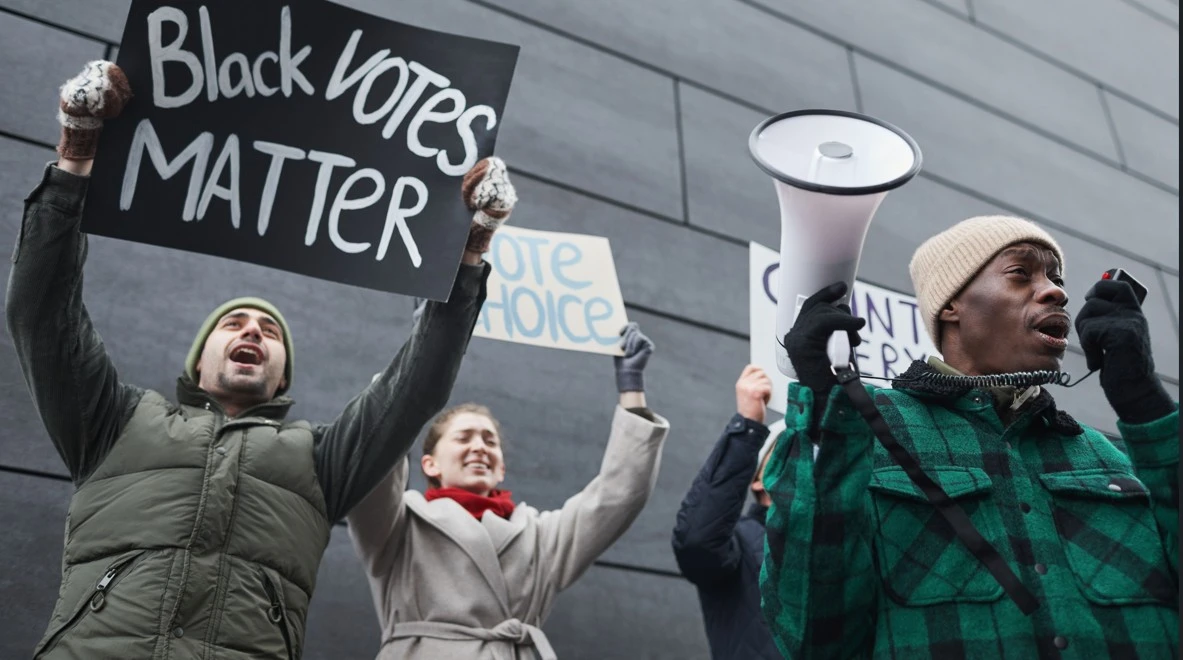
The Democratic Party’s biggest question on November 3 will not be which party Black voters support, but how many of them will turn out. Black Americans remain the Democratic Party’s most dependable voting bloc, but loyalty does not automatically translate into enthusiasm. Economic frustration, inadequate political representation, and growing distrust among younger generations could keep precisely those voters at home without whom Democrats cannot win several battleground districts and states.
In a Pew survey conducted in early October, 70 percent of registered Black voters said they would vote for the Democratic candidate for the House, while only 7 percent chose the Republican. The more revealing figure, however, is that 23 percent supported another candidate or remained undecided. The Democratic advantage is overwhelming, but only seven in ten Black voters were firmly behind the party just weeks before the midterm elections.
That uncertainty does not necessarily mean these voters have become Republicans. The greater danger for Democrats is that they will not vote at all. Black Americans make up approximately 14 percent of the U.S. population, but accounted for only 9 to 11 percent of voters in recent midterm elections. In 2022, 52.2 percent of the voting-eligible population cast a ballot, while Black voters were underrepresented nationally. Registered Americans who stayed home most often cited work, lack of time, illness, disinterest, or the belief that their vote would not make a difference. These obstacles do not affect everyone equally. Voting is easier for someone who can leave work, has a car, can arrange child care, and lives near a polling place.
At an American Community Media briefing, Dr. Andra Gillespie, an Emory University political scientist, cautioned against claims that Black voters are undergoing a lasting shift to the right. Donald Trump won 15 percent of the Black vote in 2024 and 21 percent among Black men, a significant Republican gain over previous elections. Gillespie said, however, that it would take 20 years to determine what that result actually meant and whether it marked the beginning of a historic political realignment. Black voters remain “the most consistent Democratic voting bloc.” The real question in the midterms is turnout.
The economy is the foremost influence on Black political behavior. In a summer survey, 52 percent named an economic problem as the country’s most important issue. Inflation, housing, food, health insurance, wages, and debt do not appear in their lives as abstract economic indicators. They come down to whether any money is left at the end of the month. Among Democratic voters overall, 88 percent now consider the economy very important, 23 percentage points more than before the 2022 midterms. Anger at the Trump administration may be a powerful motivator when it offers an obvious answer to a personal question: Why is someone working two jobs and still unable to get ahead?
This frustration is especially pronounced among Black men. Michael Bland, executive director of Black Men Vote, said major campaigns often talk about Black men without talking to them. They receive little personal outreach, are rarely invited into focus groups, and often see their political concerns reduced to criminal recidivism or marijuana. Black Men Vote’s own research found that employment, entrepreneurship, education, and mental health mattered far more. For Black men between the ages of 18 and 45, the question is straightforward: What will leave more money in their pockets after they studied, worked, followed the rules, and still failed to advance? Democrats often take certain districts and constituencies for granted, assuming they will vote for the party no matter what.
Trump’s image as a businessman and television celebrity appealed to some Black men because he sold them a story about a man who fell and rose again. That does not necessarily reflect an ideological identification with the Republican Party. It is a warning that someone will always try to translate the need for recognition and economic dissatisfaction into a political message. Bland believes Black men constitute one of the last large blocs of genuinely persuadable voters and could shift election outcomes in seven to 14 states.
Black Men Vote is therefore not relying on celebrities to mobilize them. The organization plans to reach 100,000 Black men through phone campaigns, community videos, gaming platforms, barbershops, churches, union halls, and college campuses. Bland’s experience suggests that a local council member, youth sports coach, or respected neighborhood business owner can speak more credibly to an infrequent voter than a star athlete can. The key to mobilization is not who can issue the loudest call to vote, but who is willing to listen first.
Turnout, however, is only one half of political participation. The other is whether the ballot cast can produce representation. Evan Milligan became nationally known as the lead plaintiff in the landmark challenge to Alabama’s congressional map. Black residents make up approximately 27 percent of Alabama’s population, yet the legislature packed them into just one of the state’s seven congressional districts where they had a realistic opportunity to elect their preferred candidate. In 2023, the Supreme Court ordered the creation of a new map. A court-appointed expert drew a second district with a substantial Black voting population, and in 2024 Shomari Figures became the first Black candidate in more than a century and a half to win election to Congress from that part of the state.
The story did not end there. The Supreme Court’s 2026 ruling in Louisiana v. Callais made racial vote-dilution claims more difficult to bring. Republican-controlled Southern states immediately began redrawing districts again. Alabama was able to restore its own map, reducing the Black voting-age population in the second district from roughly 47 percent to 40 percent and invalidating the earlier primary results. Turnout in the special primary scheduled for August was only about 5 percent. According to Milligan, Black voters are now more vulnerable than they were when the litigation began: the legal infrastructure protecting transparent, multiracial elections is being dismantled before their eyes.
This is how modern voter suppression works. No one has to declare that a Black citizen may not vote. It is enough to draw district lines so that the vote cannot produce a seat, remove infrequent voters from the registration rolls, move polling places farther away, shorten the deadline for mail ballots, or demand a photo ID, birth certificate, or passport from someone who does not readily have those documents. The rule may look identical for everyone on paper, but it imposes the greatest burden on people with less money, less time, and fewer transportation options. Those voters are disproportionately Black.
Since the 2024 election, 22 states have enacted 47 laws making it more difficult to register, remain on the voter rolls, or cast a ballot. Thirty-eight of those measures will be fully or partially in effect for the November midterms. Some states now require additional proof of citizenship, while others have tightened identification rules, mail-voting procedures, or voter-roll reviews. During the same period, 32 states also enacted 61 measures expanding access. The country is therefore restricting and broadening voting access at the same time. A voter’s practical ability to participate increasingly depends on the state and county in which that voter lives.
The first line of defense begins well before Election Day. Voters should verify their registration status, address, polling location, acceptable forms of identification, and mail-ballot deadlines. Those who can vote early have more time to correct a problem. The nonpartisan Election Protection network’s 866-OUR-VOTE hotline assists with registration, identification, and voting difficulties. Black voting-rights advocates are also pressing states to enact their own voting rights laws to replace weakened federal protections against racial vote dilution, intimidation, and deception. In 2026, five more states adopted or strengthened such laws, bringing the number of states with independent voting-rights protections to 11.
The November election will therefore be a double test. It will show whether opposition to the Trump administration, frustration with the economy, and anger over restrictions on voting rights are strong enough to bring Black voters to the polls in a midterm year. It will also reveal whether the American electoral system is capable of converting their participation into political representation.
Democrats cannot treat the Black vote as their permanent property. They must learn that they have to earn it. Republicans cannot call the contest free and fair after rewriting the rules of the game. Black voters could wield enormous power in November—but only if they reach the polls, their ballots are counted, and they cast them in districts where those votes can have real consequences.
Voting rights, after all, mean more than the right to receive a ballot. They also mean the right to have that ballot translated into political power and representation.
Comments
Comments are provided by Disqus.