
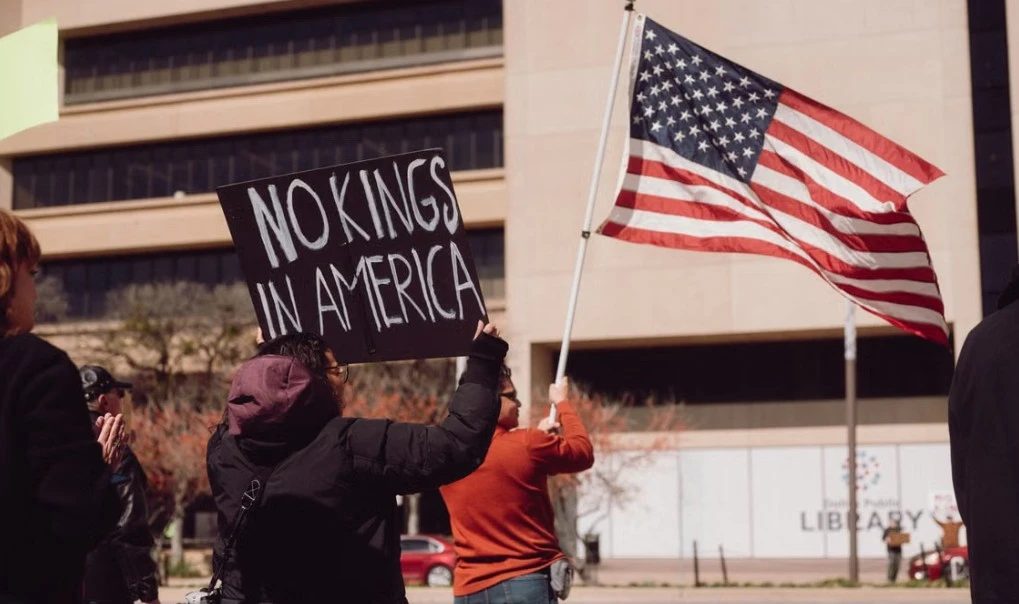
National election polls divide Americans into broad social categories. They speak of Black, Latino, Asian, Native, and White voters as though those labels alone explained why people vote as they do. Ethnic media see America at closer range. They hear not only that someone is worried about inflation, but that the family has begun buying lower-quality food. They do not merely measure support for immigration policies; they see the empty restaurant whose customers are now too afraid of ICE to visit. Ahead of the November 3 midterm elections, the same two concerns recur in almost every community: the cost of living and fear.
American Community Media brought together journalists to discuss what they are hearing. Vandana Kumar, publisher of India Currents; Lori Ann Edmo, editor of the Sho-Ban News; Nestor Fantini, co-editor of Hispanic LA; Rong Xiaoqing, a reporter for New York’s Sing Tao; Edelia Carthan, a contributor to The Mississippi Link; and Osama Siblani, publisher of The Arab American News, spoke about different states and communities separated by geography, history, and culture. Yet their accounts converged on the same conclusion: people feel that life has become more expensive and less secure, while their rights and their place in America have grown more precarious.
The economic pressure is especially severe among Latino voters. A UCLA survey released shortly before the discussion found that 76 percent of registered Latino voters in California were very worried about keeping up with the cost of living, compared with 61 percent of non-Latino voters. Forty percent of Latinos had cut spending on groceries or purchased lower-quality food during the previous two months, compared with 28 percent of other voters. Fantini said two concerns define the election for Latinos: “the wallet and la migra”—the immigration authorities.
Latino voters shifted significantly toward Trump in 2024, but those gains have not proved durable. An October Pew Research Center survey found that Trump’s approval rating among Latino voters had fallen from 38 percent in February 2025 to 24 percent. Fifty-five percent of registered Latino voters view their congressional ballot as a vote against Trump; only 14 percent intend it as an expression of support for the president. The economy remains their leading issue, but voters do not separate rising prices from immigration raids. They see them as two sides of the same administration.
Fear is already reshaping local economies. Rong Xiaoqing reported that restaurants in New York’s Chinese neighborhoods, including Sunset Park and Flushing, are seeing fewer customers, while ridership has declined on long-distance buses serving those communities. This is not necessarily because people lack money, but because they are avoiding public places and travel. Roughly two-thirds of Asian American voters were born abroad, so immigration enforcement can directly affect their families even when they themselves are U.S. citizens. A raid is not an abstract policy debate. It forces people to decide whether leaving home is safe.
At the same time, Chinese American communities are showing strong interest in early voting. This illustrates the two opposite reactions fear can produce. It keeps some people at home while motivating others to exercise their citizenship before they lose more rights. The role of community media therefore extends far beyond reporting the news. It explains voting rules in Chinese, refutes unverified claims about ICE agents appearing at polling places, and distinguishes real danger from propaganda intended to intimidate.
For South Asian voters, economic and immigration insecurity often meet in the same job. Kumar said that in Silicon Valley—usually portrayed from the outside as a place of limitless wealth—technology layoffs and the rise of artificial intelligence are causing profound anxiety. For an H-1B visa holder, losing a job is not merely a loss of income. It can jeopardize the right to remain in the United States and put an entire family’s future at risk. That pressure is compounded by expensive housing, child care, education, and responsibility for aging parents.
Indian Americans have traditionally leaned Democratic, although Republicans made gains among them in 2024. A nationwide October survey of 1,000 Indian American adults found that, after growing disillusionment during Trump’s second term, the Democratic advantage had widened again. Among respondents who were U.S. citizens, 62 percent planned to vote for the Democratic House candidate and 19 percent for the Republican, while 12 percent remained undecided. Alongside Republican immigration and economic policies, openly xenophobic attacks directed at Indian Americans have become a source of political mobilization.
The federal government means something very different in Native communities. Lori Ann Edmo, editor of the Sho-Ban News on Idaho’s Fort Hall Reservation, emphasized that federal funding for tribes is not a political gift. It is an obligation arising from treaties and lands taken from Native nations. Funding cuts affect healthcare, housing, education, and the protection of natural resources. The Shoshone-Bannock community is concerned about proposals to sell public lands or transfer them to state control because such moves could threaten treaty-protected hunting and fishing rights. “Water is life,” Edmo said, summarizing what may be an environmental issue to other voters but is a condition of survival for Native communities.
In Mississippi, the cost-of-living crisis intersects with an old system of racial inequality. Carthan described how high gasoline and grocery prices are affecting a state already burdened by food deserts, poverty, and poor access to healthcare. Mississippi still has not fully expanded Medicaid eligibility, even though doing so could provide coverage to more than 100,000 uninsured working adults. Black voters also face a historic opportunity in the Senate race: Scott Colom could become the first Black candidate since Reconstruction to win statewide office in Mississippi. Carthan said it is no accident that this has not happened in more than 150 years in the state with the nation’s largest share of Black residents. The outcome was created and preserved through political means.
Arab American voters in Michigan abandoned Democrats in large numbers in 2024 because of the war in Gaza and the Biden administration’s policy toward Israel. Two years later, they have not simply returned to their former partisan loyalties, but Trump’s policies have again altered the political landscape. According to an October Arab American Institute survey, 59 percent planned to vote for the Democratic House candidate and 26 percent for the Republican. A record 31 percent identified as independents, while 82 percent said rising prices had caused them economic hardship. Sixty-five percent reported experiencing discrimination because of their ethnicity or national origin, up from 53 percent in 2023.
Siblani said political hatred toward Muslim and Arab Americans has reached a level his community did not experience even after September 11, 2001. Some of the attacks have targeted Abdul El-Sayed, the Democratic Senate candidate in Michigan, but their broader message is directed at every Arab and Muslim American: that their names, religion, and manner of worship make them less American. This hostility does not only intimidate; it also mobilizes. According to the Arab American Institute, a majority say hateful political attacks make them more likely to participate in public life.
There is no recent, nationally representative survey of Hungarian American voting behavior. The community is geographically dispersed and divided across generations, while the people involved in its institutions do not represent the entire U.S. population of Hungarian descent. Any precise percentage would therefore create a false impression of certainty. Yet the organized community visible in churches, clubs, and traditional associations has long been strongly conservative and Republican. Liberal and left-wing Hungarians have gradually been pushed out of many of these organizations, making the publicly visible “Hungarian community” appear far more politically uniform than Hungarian America actually is.
Leaders of traditional organizations and religious figures often encourage their members, openly or implicitly, to vote Republican. In recent years, the political alliance between Trump and Viktor Orbán reinforced that tendency. In some circles, Republican identity came to signify not only a choice between American parties but also loyalty to the Orbán system. Orbán’s electoral defeat in Hungary, however, has weakened that emotional and political bond. Trump is no longer the American ally of a victorious leader in the homeland, and Orbán-aligned Hungarian communities have lost the appearance that history is on their side.
Economic hardship may also prove stronger than ideological loyalty. Many people active in traditional clubs and church communities are older and of modest means, making them directly vulnerable to rising food, insurance, housing, and prescription-drug costs. Hungarians working in agriculture or related industries feel the effects of tariffs, higher diesel prices, and rising production costs. They may not have become Democrats, but some now find it harder to believe that everyone except the government is responsible for their personal losses.
Liberal and left-wing Hungarian Americans organize in a different environment. They are less visible in traditional institutions and more likely to find one another online. They have no national voter-mobilization organization, but their political interest is intense. They encourage one another to participate and see the midterms as an opportunity to remove Trump or constrain his power. For them, voting Democratic is not an expression of enthusiastic party loyalty. It is a means of defending the rule of law, immigrants, minorities, and the constitutional system.
The midterm election will not realign ethnic communities by moving every minority group in the same direction at the same time. People arrive at the same ballot box carrying different historical experiences and facing different immediate threats. Latino voters are thinking about ICE, Native voters about treaty rights and water, Chinese Americans about their families’ safety, Indian tech workers about their visas, Black voters in Mississippi about a century and a half of political exclusion, and Arab Americans about the war in Gaza and the hatred directed against them. Hungarian Americans are weighing both their lives in the United States and the political loyalties they carried from their homeland.
The common denominator is nevertheless clear. The most organized communities are those that understand that staying home is not a protest; it merely increases someone else’s power. The role of ethnic media is not to manufacture them into a uniform voting bloc, but to show them in their own languages that what is happening to them is not a private misfortune. It is politics.
On November 3, the pocketbook, fear, and human dignity will all be on the ballot.
Comments
Comments are provided by Disqus.