
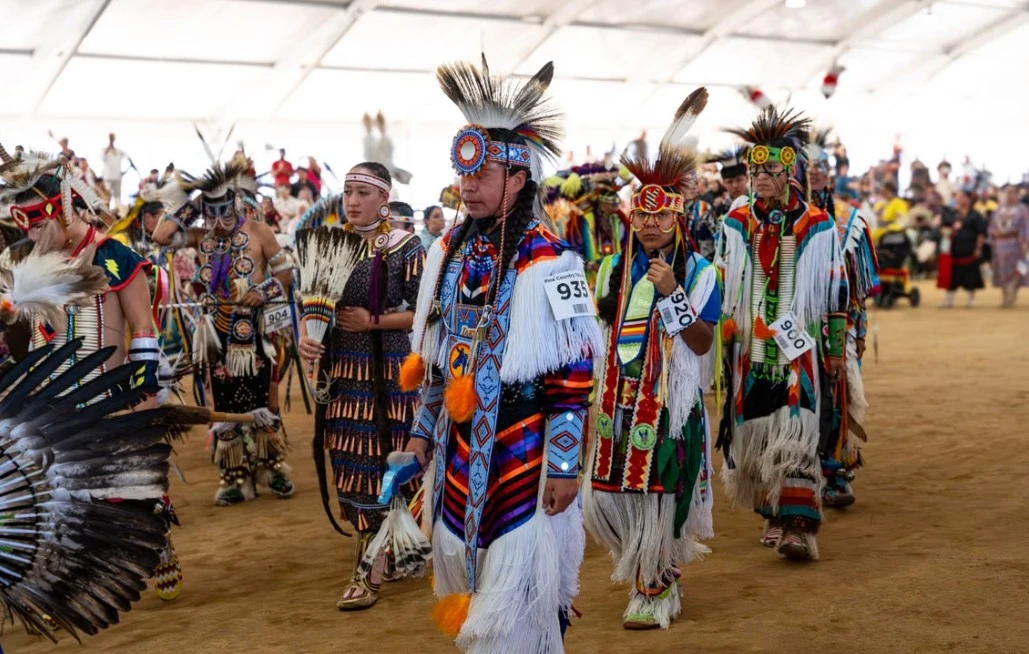
There are enough Native voters in the United States to decide close Senate, House, and gubernatorial races, yet too few to receive sustained attention from the national campaigns of either major party. Their votes could be especially consequential on November 3 in Alaska, Arizona, Michigan, Montana, Maine, Minnesota, and New Mexico. Yet the same question arises before this election as it has before so many others: Will candidates notice them before they need their votes?
In the 2020 census, 9.7 million people identified as American Indian or Alaska Native, either alone or in combination with another racial identity. That is nearly 3 percent of the country’s population. But the figure encompasses many profoundly different communities. The United States has 575 federally recognized tribes, 231 of them in Alaska and the rest spread across 37 states. They have their own governments, legal status, languages, histories, and distinct agreements with the United States. There is therefore no single social or political type that can be called “the Native voter.”
More than half of the population identifying as American Indian lives in five states: Oklahoma, Arizona, California, New Mexico, and Texas. More than three-quarters of Alaska Natives live in Alaska. Yet Native America is not confined to reservations. According to an analysis by the First Nations Development Institute, 54 percent of American Indians and Alaska Natives live in rural communities, on reservations, or within 20 miles of one. The rest live in cities, suburbs, or far from tribal lands, but that does not necessarily sever their ties to their communities or political interests.
“Assimilation” is therefore a misleading concept. A Native person living in Phoenix, Minneapolis, or Los Angeles can simultaneously be an urban American and a citizen of a tribal nation. That person may vote in federal, state, and tribal elections while maintaining family, cultural, and economic ties to the reservation. In 2024 research, 82 percent of respondents living on or near reservations said they considered tribal issues when voting. Even among urban residents, the figure was 72 percent. Physical distance does not erase the importance of tribal sovereignty.
At an American Community Media briefing, Michael Roberts, president and CEO of the First Nations Development Institute, described Native voters as politically “invisible.” Polls represent them through samples that are too small and imprecise, while the media frequently draw national conclusions from the responses of only a few hundred people. After the 2024 election, a widely cited exit poll based on only about 228 Native respondents claimed that 65 percent had voted for Trump. Another survey of approximately 500 Native voters found the opposite: 57 percent supported Kamala Harris and 39 percent backed Trump. Not one polling place included in the first survey was located on tribal land. Such methods do more than produce inaccurate results. They manufacture a single, unified “Indian voting bloc” that does not actually exist.
Native voters’ partisan choices cannot be inferred automatically from their identity. Land rights, tribal self-determination, and the protection of language and cultural heritage may lead many toward Democrats. Religious conservatism, gun rights, energy extraction, and the interests of rural economies can generate Republican support. Some tribes derive revenue from casinos and tourism, others depend on mining or oil and gas production, while still others see the protection of natural resources as essential to their survival. Native politics cannot be arranged along a single left-right axis.
In 2024 data, 59 percent of respondents identified land rights as an important issue, 58 percent cited tribal sovereignty, and 49 percent named the preservation of cultural and linguistic heritage. Inflation and the cost of living were a top concern for 40 percent. Roberts said Native people are often portrayed as exotic communities existing outside ordinary society, when they ask the same questions as other Americans: Do they have decent jobs, adequate housing, passable roads, accessible healthcare, and the means to support their families?
The difference is that these issues are often directly connected to sovereignty. Funding for a road, hospital, water system, or school is not merely a budget question. It is a test of whether the federal government will honor its treaty and trust obligations to tribal nations. When Native voters demand these services, they are not asking the government for special treatment. They are demanding fulfillment of commitments made in exchange for land and power surrendered by their nations.
Political interest, however, is not enough when voting requires a disproportionate investment of time and money. Melissa Rogers, a professor of political science and public policy at Claremont Graduate University, noted that participation declines as its practical cost rises. Registration offices and polling places are often established in county seats that are considerably farther from reservations than from other communities.
Residents of Nevada’s Duck Valley Reservation once had to travel nearly 200 miles round trip to reach the county polling place. They were offered only eight hours of early voting on their own land, divided between two days, while other county residents received 120 hours. The Shoshone and Paiute Tribes went to court and secured a voting center on the reservation. Rogers said turnout rose wherever registration and voting were brought onto tribal land. The change not only reduced the burden of travel; it also increased voters’ confidence that their ballots would actually be counted.
According to the Native American Rights Fund, more than 1.5 million of the nation’s 4.7 million voting-age Native people—34 percent of those eligible—were not registered in 2020. The distinctive barriers they face have not disappeared. Many homes on reservations lack conventional street addresses recognized by state databases. Mail is not delivered to residences, forcing people to travel to distant post offices and rent P.O. boxes. Some Navajo voters in Arizona travel 40 to 150 miles simply to collect their mail. Tribal identification is not accepted at every polling place, while poor internet service can make online registration difficult or impossible.
New data show that in counties where at least a quarter of the population is Native, rejection of registration applications submitted by mail or through motor vehicle offices increased by an average of 200 percent between 2020 and 2024, even as the national rate declined. Rejection of mail ballots arriving after the deadline rose by 134 percent in those counties, compared with a 55 percent increase nationwide. Even after some improvement, the share of provisional ballots ultimately counted remained 15 percent below the national rate. Voting rights do not fail here at a single barrier. They can collapse at multiple points along the chain, from registration and mail delivery to the final counting of the ballot.
Campaigns, meanwhile, barely contact these voters. Half of the Native people surveyed in 2024 received no outreach from either the Democratic or Republican Party. Roberts does not expect a fundamental change before this year’s election, while organizations conducting community-based mobilization remain chronically underfunded. It is a remarkable form of political blindness: in a state decided by a few thousand votes, the decisive community may be the one neither party is willing to visit.
Representation is even more disproportionate. At the beginning of the 119th Congress, only four American Indian senators or representatives served in the 535-member legislature—less than 1 percent—although nearly 3 percent of the country’s population identifies as Native. This year’s election nevertheless offers signs of a possible shift. At least 355 Native and other Indigenous candidates have run or are running for local, state, and federal office, compared with the previous record of 263 in 2024. Deb Haaland is seeking the governorship of New Mexico, Mary Peltola is running in Alaska, Peggy Flanagan in Minnesota, and Jonathan Nez in an Arizona congressional district. The number of candidates does not guarantee victory, but it shows that Native communities are no longer simply waiting for the parties to notice them.
Judith LeBlanc, executive director of the Native Organizers Alliance, said representation is not the destination but an opportunity to give communities their own voice in shaping solutions. Her organization works with local activists in 25 Native communities and is seeing a sense of urgency among young people that was not as apparent in 2024. This generation is confronting climate change, a housing crisis, language loss, and decisions that narrow tribal rights—all at the same time.
In Maine, Sage Phillips, a citizen of the Penobscot Nation, helped create the Wabanaki Policy Youth Initiative after visiting the state legislature and seeing that young Wabanaki people were absent from the rooms where decisions about them were being made. The 20-member group registers voters, questions candidates, and meets with both elders and younger generations. Its members are working to change laws enacted before they were born that exclude Wabanaki nations from federal rights available to other tribes. Phillips said they do not need candidates who will write more rules for them. They need candidates who will finally ask what they want.
In Florida, the immigration detention facility known as “Alligator Alcatraz” demonstrated what happens when tribal sovereignty is ignored. The facility was constructed in the Big Cypress region, which the Miccosukee Tribe considers ancestral and sacred land, without meaningful tribal consultation or a prior environmental review. Ten traditional tribal villages are located within three miles of the site, one of them barely 1,000 feet from the detention camp. The area contains ceremonial grounds and burial sites. Tribal members hunt and fish there, and their children’s school buses travel nearby. Light from the facility even interferes with religious ceremonies that use the stars for orientation. The Miccosukee Tribe therefore joined the lawsuit challenging the project.
The case also demonstrates why Native politics cannot be reduced to party loyalty. While suing the Republican state and federal governments, the tribe contributed campaign money to Republican candidates, including one supporter of “Alligator Alcatraz.” It also financed Democratic candidates and committees. From the outside, this may look contradictory. For tribal governments, however, it is often a survival strategy: they must negotiate with politicians from whichever party holds power. Miccosukee leaders say they seek allies wherever they find a willingness to protect the Everglades, water quality, and tribal rights.
There will therefore be no single “Indian vote” in November. There are, however, shared experiences: political invisibility, inadequate representation, participation made more expensive by the state, and the historical knowledge that the government can easily forget its treaties. Native voters can become a genuine political force only if they can reach the polls, are counted accurately, and are noticed before the final days of an election.
The question is not whether their votes matter. In closely divided states, the math alone makes them potentially decisive. The question is whether the American political system is willing to treat Native people as citizens with their own governments, treaty rights, and political will—not as part of the scenery of a long-vanished America, remembered in ceremonial speeches while others continue to make decisions for them in the present.
Comments
Comments are provided by Disqus.