
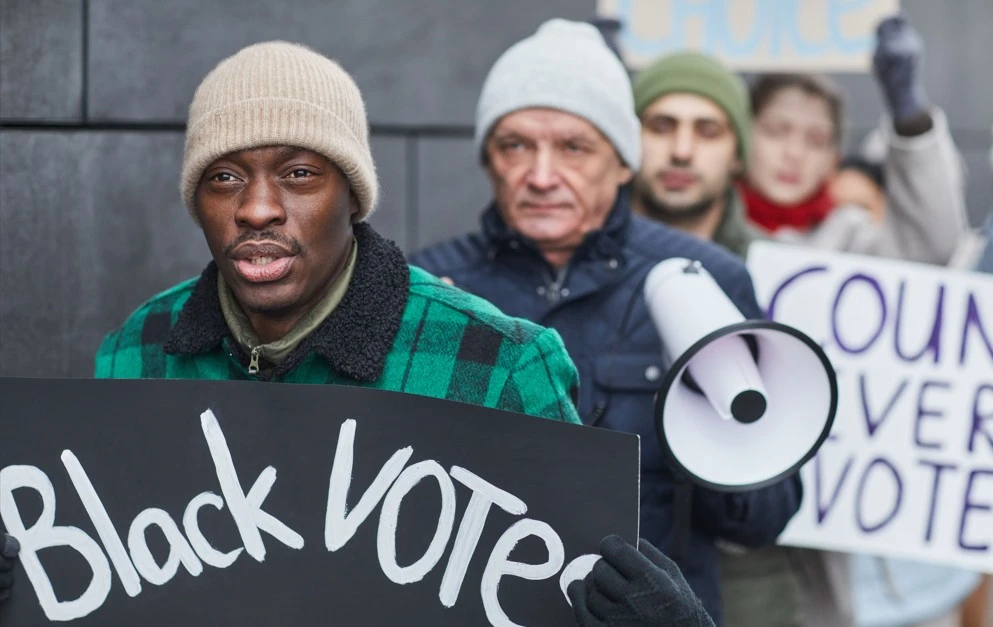
In the United States, the right to vote is rarely taken away through a single, explicit prohibition. A far more effective method is to pile one small obstacle on top of another. Move the polling place farther away. Shorten its hours. Make registration more complicated. Tighten identification requirements. Provide less language assistance. Make mail voting less reliable. Leave naturalized citizens wondering whether immigration agents might appear near the polls.
Each rule, viewed separately, may look like a technical detail. Together, they determine who can actually exercise the rights that democracy promises.
About 250 million Americans are eligible to vote in the 2026 midterm elections. The electorate is changing rapidly. Over the past 20 years, the share of eligible voters who are Latino has nearly doubled and now stands at 16 percent. The Asian American share has also nearly doubled, reaching 5 percent, while Black voters account for 12 percent of the electorate. White voters remain the majority, but their share has declined from 69 percent in 2006 to 61 percent today.
The political struggle is therefore not merely about which party can persuade these growing minority communities. It is also about the kind of election system through which their votes can be translated into representation.
The 2024 presidential election produced high turnout, but it did not eliminate racial disparities. Among eligible voters, 70.5 percent of non-Hispanic white Americans cast ballots, compared with 59.6 percent of Black voters, 57.1 percent of Asian American voters and 50.6 percent of Latino voters.
The gap was even wider in the 2022 midterms. White turnout reached 57.6 percent, compared with 45.1 percent among Black voters, 40.2 percent among Asian Americans and 37.9 percent among Latinos. The question is therefore not simply whether the mobilization of 2024 can be repeated in 2026. It is whether voters from minority communities are even starting on the same playing field.
The most consequential changes can be seen on congressional maps. Nine states are holding the midterm elections under new district lines, and nearly 10 percent of voters have been moved into a different district. Modern technology can predict, almost block by block, which electoral outcome a particular map is likely to produce.
Gerrymandering is no longer a crude line drawn with a pencil. It is precision political engineering. Minority voters can be packed into a small number of districts or divided among several districts so that they cannot elect a representative in any of them.
Supreme Court decisions have further weakened the protections of the Voting Rights Act, particularly the legal tools used to create and preserve districts in which Black voters can elect candidates of their choice. Of the 435 seats in the House of Representatives, only about 32 are now considered genuinely competitive.
When district maps predetermine the overwhelming majority of elections, the political power of minority voters is not the only casualty. Representatives also have less reason to seek compromise with other social groups. Gerrymandering therefore weakens representative government while strengthening political extremism.
For Native American communities, exercising the right to vote can require a literally long journey. Jacqueline De León, senior staff attorney at the Native American Rights Fund, described reservations where voters must travel 20, 50 or sometimes 100 miles to register or reach a polling place.
Many homes do not have conventional street addresses, leaving voter-registration systems unable to process their locations. Mail is not delivered to the home, forcing voters to rent post office boxes at distant facilities, even when they have no car and no access to public transportation. Poor roads, poverty and unequal access to early voting give the same legal right a radically different practical value.
Voter identification requirements also appear neutral until their real cost is examined. Thirty-eight states require some form of identification to vote. Georgia offers a free voter identification card, but obtaining one requires other documents, a trip to a government office and often repeated visits.
Monica Spencer, Georgia state director of VoteRiders, recalled one woman who had to visit the Department of Driver Services five times because officials informed her on each occasion that she needed yet another document. Others left their identification papers behind while fleeing domestic violence, or reached old age without being able to obtain a copy of their birth certificate.
The law may call the identification card free. The voter still pays for supporting documents, transportation, lost working hours and child care. If there is no car, bus, taxi or nearby government office, a free ID remains a theoretical possibility.
That is why Spencer’s organization does more than distribute information. It obtains documents, pays fees and arranges transportation. In many cases, civil society organizations make the right to vote usable where the state has provided it only on paper.
In Texas, registration itself is an obstacle course. The state does not offer universal online voter registration. A form can be downloaded, but the completed document must be delivered to election authorities through an approved method, generally at least 30 days before Election Day.
Jesús Zamora, field director for Mi Familia Vota, said the organization’s staff members go door to door helping Latino voters complete the forms, locate their polling places and arrange transportation. A single error can delay registration for weeks.
Mail voting is not a universal escape route. Texas permits it only for specific categories of voters, including those who are 65 or older, sick or disabled, outside their county during the voting period, or confined in jail but still eligible to vote.
Simply being unable to reach a polling place easily does not necessarily qualify someone to vote from home. The rule therefore offers no relief to many people who lack a car, work two jobs or care for a family member.
Language barriers can also exclude voters without anyone explicitly telling them they may not vote. John C. Yang, president and executive director of Asian Americans Advancing Justice, emphasized that advanced English proficiency is not a condition of the right to vote.
Under Section 208 of the Voting Rights Act, eligible voters may choose someone to assist them, as long as that person is not their employer or union representative. Certain election jurisdictions must also provide multilingual information and voting assistance. But a legal right has value only if the voter knows about it and the local election official honors it.
Especially dangerous is the fear that ICE agents could appear at polling places. The Department of Homeland Security has said it does not plan a general deployment of immigration agents to the polls, but administration officials have not completely ruled out individual operations.
Federal law sharply restricts the presence of armed federal forces at election sites, and there is no evidence that noncitizens vote in significant numbers. Yet uncertainty alone can deter a naturalized citizen or a member of a mixed-status family from going to the polls.
Yang said unverified reports of ICE activity at voting sites should not be repeated as fact, but the fear behind them cannot be dismissed. A naturalized citizen voting lawfully does not have to prove the immigration status of every family member. The purpose of disinformation may be to persuade people to surrender voluntarily a right that would be more difficult to take from them openly. Yang therefore urged voters not to let fear keep them from the polls.
Election barriers do not affect every community in the same way. An Asian American voter may need language assistance or a mail ballot. Redistricting may fracture the political strength of a Black community. The climate created by immigration raids may keep a Latino citizen away from the polls. A Native American voter may have to travel 100 miles to obtain the same ballot.
These are not random inconveniences. Throughout the history of American elections, the greatest barriers have repeatedly appeared before communities whose growing political power threatened the existing balance of power.
The answer cannot simply be that everyone should try harder. Civil rights organizations operate hotlines, obtain identification documents, arrange transportation, send poll monitors to reservations, explain election rules in multiple languages and bring lawsuits. Their work is indispensable, but it also reveals an unacceptable reality: Private organizations are attempting to repair what a democratic government should have guaranteed in the first place.
Turnout in 2026 will show whether minority communities can overcome these barriers. But the quality of a democracy is not demonstrated by the fact that its most determined voters eventually make it to the polls. The real test is whether the state gives everyone an equal opportunity to participate.
Voting rights are not equal merely because the same sentence appears in the law for everyone. They are equal only when every voter faces the same distance, cost, fear and bureaucratic burden between themselves and the ballot.
In America today, they do not.
Comments
Comments are provided by Disqus.