
Donald Trump’s administration tried to impose an election rule that would have allowed the U.S. Postal Service to refuse to handle some legally cast mail ballots. The rule would not have formally stripped anyone of the right to vote. It chose a more devious method: It imposed data-upload, envelope-design and barcode requirements that more than 10,000 local election authorities would have had only weeks to meet. If a piece of data or a barcode failed to match perfectly, the Postal Service simply would not have accepted the election mail. The citizen would have retained the right to vote. Only the ballot would never have arrived.
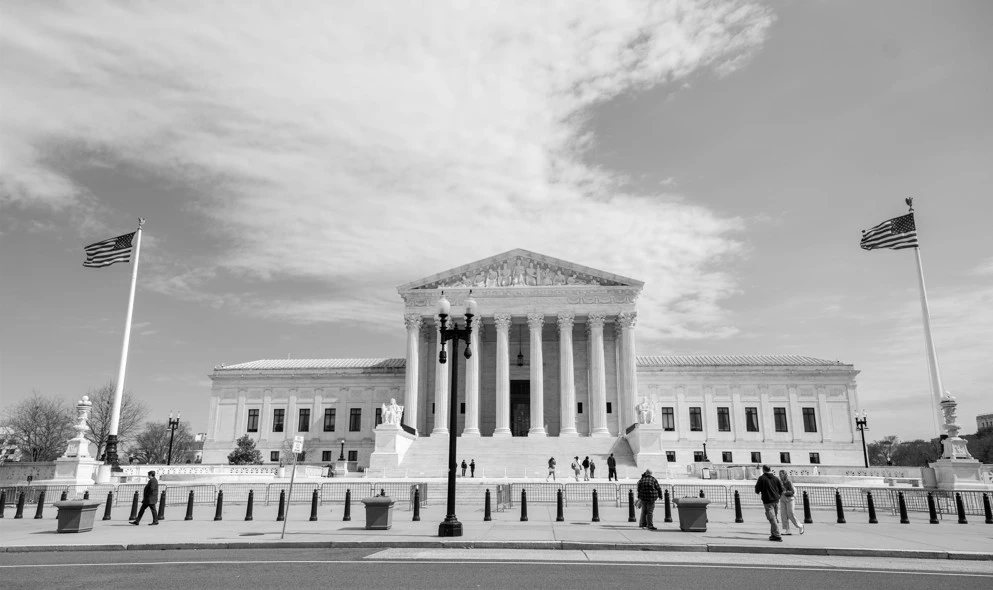
On September 14, the Supreme Court voted 7–2 to reject the administration’s request to suspend a preliminary injunction blocking the new rule. The decision did not resolve the lawsuit permanently, but it ensured that states could continue using their existing mail-voting systems in the November 3 midterm elections. The Postal Service may not refuse to carry valid election mail because an envelope fails to comply with a system the Trump administration devised only weeks before the election.
The rule grew out of Trump’s March 31 executive order. The order invoked election “integrity,” but it would have fundamentally transformed the Postal Service’s role. Instead of simply delivering ballots sent to voters whom state authorities had determined were eligible, USPS would have established its own federal verification system. Every state and local election office would have been required to upload each mail voter’s name, address and unique barcode to a new federal portal. Only voters registered in advance through that system would have been able to receive and return their ballots.
The system was not operational even as the administration sought to make it mandatory. In federal court, a Justice Department attorney was forced to acknowledge that the data-upload portal was not ready to function. A Postal Service official confirmed the same fact in writing. Postal employees had not been trained to apply the new rule, while election offices had already designed, ordered or printed their envelopes. John Cusick, assistant counsel at the NAACP Legal Defense Fund, said the Postal Service was attempting to become “the gatekeeper of every vote” less than 70 days before the election.
The Trump administration described the change as a safeguard against fraud, but it produced no evidence of mail-ballot fraud on a scale that could justify putting millions of legitimate votes at risk. Fraud involving mail ballots is exceedingly rare. The proposed system, by contrast, would certainly have denied delivery to eligible voters who had done nothing wrong. An unreadable barcode, a differently formatted address, a typographical error or a local election office’s inability to upload data on time would have been enough.
Civil rights organizations therefore based their challenge on more than the right to vote. The case raised a fundamental constitutional question: Who has the authority to regulate federal elections? The Constitution assigns the administration of elections to the states, subject to congressional oversight. A president cannot rewrite state election procedures by executive order, and Congress created the Postal Service to deliver mail, not to operate a national election-supervision system.
A coalition led by the League of Women Voters of Massachusetts brought together attorneys from the ACLU, the Brennan Center for Justice, the Legal Defense Fund and Asian Americans Advancing Justice. The coalition’s strength was that it did not rely on a hypothetical danger. It showed how mail voting operates across more than 10,000 local election jurisdictions with different systems, when ballots begin going out, how many envelopes had already been printed and what would happen if a nonfunctioning federal system were imposed immediately.
The legal strategy evolved in response to the administration’s moves. A federal court in Boston initially blocked enforcement of Trump’s executive order. In a separate case in August, the Supreme Court concluded that the order could not yet be challenged because it merely directed the government to begin rulemaking. But three days before that decision, the Postal Service had already issued its final rule. The civil rights coalition amended its complaint and challenged the existing USPS rule directly.
On September 4, U.S. District Judge Indira Talwani found that the threat of unlawful disenfranchisement was both likely and imminent. The federal appeals court in Boston concluded that the rule could deprive millions of people of their votes while doing little or nothing to improve election security. The administration then appealed to the Supreme Court, but only Justices Samuel Alito and Clarence Thomas supported immediate implementation.
In a separate opinion, Justice Brett Kavanaugh indicated that the Postal Service might have some regulatory authority in this area, but he acknowledged that election officials had not been given enough time to comply.
Ethan Herenstein, a staff attorney with the ACLU Voting Rights Project, said the situation for the November election is clear: The Postal Service may not refuse to deliver mail ballots. The lawsuit will continue, however, because the preliminary injunction protects only the midterm election. This administration, or a future one, could try to revive the rule, which is why the plaintiffs are seeking a permanent injunction.
The stakes are enormous. More than 48 million Americans, nearly one-third of all voters, cast their ballots by mail in the 2024 election. Eight states and Washington, D.C., may conduct elections entirely by mail. Among Asian American voters, the rate of mail voting approached 50 percent.
For these voters, as well as seniors, people with disabilities, rural residents, military personnel stationed overseas, students attending school away from home and voters who need language assistance, voting by mail is not merely a convenience. It is often the condition that makes participation possible.
Niyati Shah, senior director of litigation at Asian Americans Advancing Justice, warned that one purpose of the administration’s attack was to create confusion and fear. In families with mixed immigration status, a U.S. citizen can vote from home without worrying about what kind of law-enforcement presence might be waiting near a polling place. Mail voting also gives people time to understand a long, complicated ballot or one written in a language that is not their first.
Justin Lam, counsel in the Brennan Center’s Democracy Program, said the Supreme Court’s decision was a victory not only for voters but also for election officials. It rejected an attempt that, under the banner of election security, would have made the election system unworkable. The rule did not close an identified security gap. It would have created thousands of new opportunities for error.
The political direction of the attack was no accident. Since his defeat in 2020, Trump has claimed without evidence that mail voting is a source of massive fraud, even as he has continued to vote by mail himself. Democratic voters have used mail ballots at higher rates in recent elections, but the restriction would not have harmed only Democrats. Elderly Republicans, rural conservatives and members of the military serving overseas could just as easily have had their ballots stopped by a faulty barcode.
That is what made the civil rights coalition so important. The organizations were not protecting the voters of one political party. They were defending the principle that the government may not arbitrarily change election rules after voting has already begun. The victory also demonstrated that voting-rights litigation is most effective when legal action is supported by technical expertise, local experience and cooperation among different communities.
The danger has not disappeared. The rule has been kept out of force only for this election, while the political assault on mail voting continues. The next attempt will probably begin earlier, be more technically sophisticated and once again be sold as a measure to protect election security.
The September ruling is therefore both a victory and a warning. The right to vote is protected not only because it appears in the Constitution, but because someone notices in time when the government tries to hide its theft behind a barcode.
Comments
Comments are provided by Disqus.